




Naples
Visit Naples, the capital of Campania, with its UNESCO-listed historic centre, the Veiled Christ and its view of Mount Vesuvius.
See our guidesActivities
Naples
Visit
Naples
Visiting Naples: the lively capital of southern Italy
The capital of Campania and the third-largest city in Italy after Rome and Milan, Naples stretches along its bay, between Mount Vesuvius and the Phlegraean Fields. Founded by the Greeks as Parthenope, then refounded as Neapolis, it has a historic centre listed as a UNESCO World Heritage Site since 1995. Everything blends together here: Baroque churches, lively lanes, ancient remains and pizzas fresh from the oven. A city full of character, ideal for a city break of a few days.
What to see in Naples?
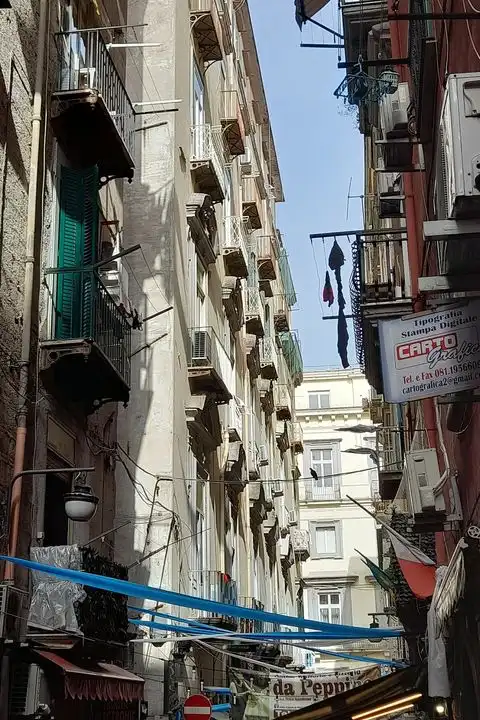
Start with the historic centre. Spaccanapoli, the former decumanus inferior of the Greco-Roman city, runs through it in a straight line. A short walk away, Via San Gregorio Armeno is lined with nativity-figure workshops, and the Sansevero Chapel houses the Veiled Christ by Giuseppe Sanmartino, carved in 1753 from a single block of marble. A little further north, the Duomo holds the Treasure Chapel of San Gennaro, the city’s patron saint. And beneath the paving stones, the tunnels of Underground Naples tell more than 2,000 years of history.
Continue with the National Archaeological Museum, which holds a large share of the treasures found in Pompeii and Herculaneum, including the Alexander Mosaic. Then walk back down through the Quartieri Spagnoli, a grid of lanes laid out in the 16th century and home to the famous Maradona mural, to the Galleria Umberto I, built between 1887 and 1890, and the Teatro di San Carlo, inaugurated in 1737.
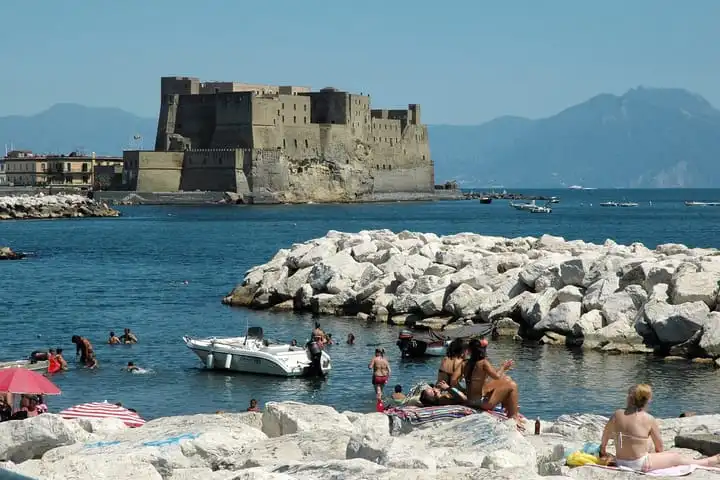
By the sea, Piazza del Plebiscito opens up between the Royal Palace and the Basilica of San Francesco di Paola. A few minutes further on, Castel dell’Ovo stands on the islet of Megaride, at the end of the seafront promenade. For the finest view over the bay and Vesuvius, head up Vomero hill to Castel Sant’Elmo, a star-shaped fortress built between 1537 and 1547.
We cover it all, day by day, in our article Visiting Naples in 3 days.
What are the must-sees in Naples?
- 🚶 Spaccanapoli and Via San Gregorio Armeno, in the heart of the historic centre
- 🗿 The Veiled Christ in the Sansevero Chapel
- ⛪ The Duomo and the Treasure Chapel of San Gennaro
- 🔦 Underground Naples and its tunnels
- 🏛 The National Archaeological Museum and the treasures of Pompeii
- ⚽ The Quartieri Spagnoli and the Maradona mural
- 🎭 The Galleria Umberto I and the Teatro di San Carlo
- ☕ Piazza del Plebiscito, between the Royal Palace and the basilica
- 🌅 Castel dell’Ovo and the seafront at sunset
- 🏰 Castel Sant’Elmo, for the view over the bay and Vesuvius
How long should you spend in Naples?
Allow 3 days. The first for the historic centre, the second for the archaeological museum, the Quartieri Spagnoli and the seafront, the third for a trip to Pompeii or a stroll on Vomero hill. With one or two more days, you can add an island in the bay or the Amalfi Coast without rushing.
What to see around Naples?
Naples is an excellent base for exploring Campania:
- Pompeii, reached on the Circumvesuviana train on the Naples–Sorrento line (Pompei Scavi – Villa dei Misteri stop). The archaeological sites of Pompeii, Herculaneum and Oplontis are UNESCO-listed.
- Mount Vesuvius, the volcano that towers over the whole bay.
- Capri, Ischia and Procida, the islands served by ferries from the port of Naples.
- The Amalfi Coast and the Royal Palace of Caserta, two more World Heritage Sites in Campania.
Visiting Naples: official websites
Frequently asked questions
The historic centre is best explored on foot. Metro Line 1 links the central station (Garibaldi) with Municipio, Toledo, Dante and Museo, and funiculars run up Vomero hill. From the airport, the Alibus coach goes to Piazza Garibaldi and Piazza Municipio.
Allow 3 days to see the historic centre, the archaeological museum, the Quartieri Spagnoli and the seafront, with a day in Pompeii. Add one or two days for an island in the bay or the Amalfi Coast.
Yes. Its historic centre has been a UNESCO World Heritage Site since 1995, and the city brings together a major archaeological museum, Baroque churches, the view of Vesuvius and Neapolitan pizza, whose craft has been recognised by UNESCO since 2017.
Pompeii, reached by train on the Circumvesuviana, Herculaneum and Mount Vesuvius. Ferries to Capri, Ischia and Procida leave from the port of Naples, and both the Amalfi Coast and the Royal Palace of Caserta are UNESCO-listed.
Naples has a Mediterranean climate, with hot, dry summers and mild, rainy winters. We recommend spring or early autumn for exploring the city on foot. In summer, plan your visits early in the morning.